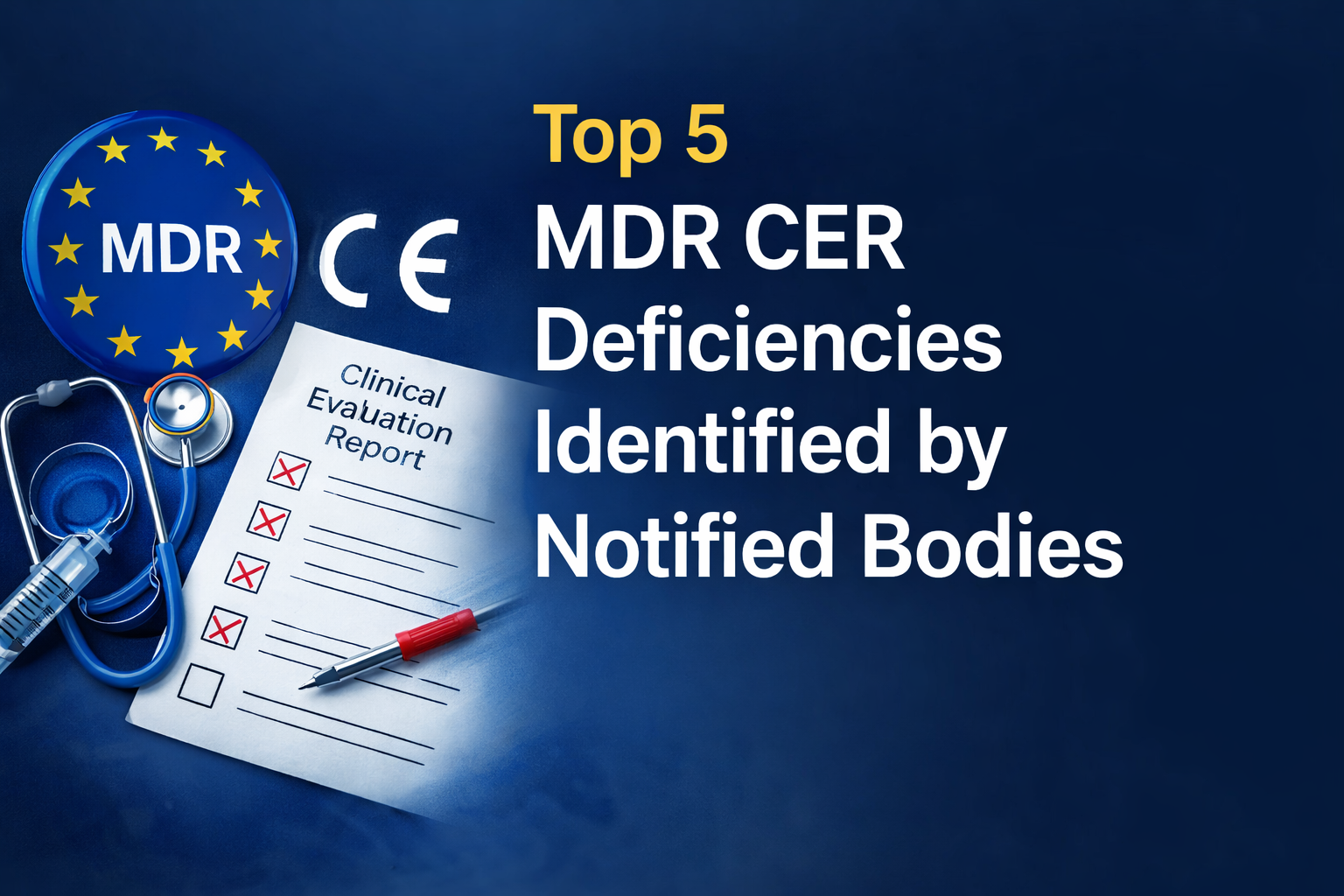
Under MDR (EU) 2017/745, Clinical Evaluation Reports (CERs) are assessed with significantly increased scrutiny. Based on common Notified Body (NB) review structures and CEAR assessment templates, the following five deficiencies are most frequently identified during conformity assessments.
1. Inadequate Clinical Evaluation Plan (CEP) Alignment with Annex XIV
One of the most common findings is a CEP that does not fully comply with Annex XIV Part A.
Typical issues include:
- Missing justification for the level of clinical evidence
- No clear identification of GSPRs requiring clinical data
- Undefined clinical benefit endpoints
- Weak definition of risk-benefit acceptability criteria
- Superficial PMCF planning
Notified Bodies explicitly verify whether the CEP content satisfies Annex XIV and MDCG 2020-13 requirements. If the CEP is weak, the entire CER foundation collapses.
2. Insufficient Demonstration of Clinical Safety and Residual Risk Analysis
Another major deficiency relates to clinical safety assessment.
Frequent problems:
- No structured qualitative and quantitative safety analysis
- Residual risks not clearly identified
- Side effects listed without data-based evaluation
- Poor alignment with risk management documentation
NB reviewers check whether:
- Clinical safety methods are defined
- Residual risks are justified
- Risk-benefit remains acceptable under normal conditions of use
A CER that summarizes safety without structured analysis is often rejected.
3. Weak Equivalence Justification (Annex XIV Section 3)
Equivalence is one of the most misunderstood areas under MDR.
Common NB findings:
- Only technical similarity shown
- Biological equivalence not demonstrated
- Clinical equivalence insufficiently justified
- No access to equivalent device data
- Lack of contract (for Class III / implantables)
MDR requires simultaneous demonstration of:
- Technical equivalence
- Biological equivalence
- Clinical equivalence
Failure in any of these three pillars results in a major nonconformity.
4. Poor Literature Search Methodology
A CER may contain many references but still fail methodologically.
Typical NB concerns:
- No defined search protocol
- Missing inclusion/exclusion criteria
- No PRISMA flow
- No duplication control strategy
- Lack of unfavorable data discussion
Notified Bodies evaluate whether the literature review follows systematic and objective criteria (e.g., PRISMA, PICO, CENTRAL)
Quantity of articles does not replace methodological rigor.
5. Inadequate PMS / PMCF Integration into CER
MDR requires clinical evaluation to be a living process.
Frequent deficiencies:
- CER update frequency not justified
- PMCF not clearly linked to identified risks
- PMS data summarized but not clinically interpreted
- No feedback loop between post-market data and risk-benefit conclusion
NB templates explicitly assess:
- PMS Plan reference
- PMCF Plan adequacy
- PSUR integration
- Update regularity
A CER disconnected from PMS is considered non-compliant under MDR.
Why These Deficiencies Matter
Under MDR, Clinical Evaluation is no longer a literature summary. It is a structured regulatory argument demonstrating:
- GSPR compliance
- Clinical safety
- Clinical performance
- Acceptable benefit-risk profile
- Continuous post-market validation
Notified Bodies assess this using structured CEAR frameworks
— meaning weaknesses are quickly visible.